
- Rohit Sohanlal (Author)
Sohanlal v. RockIT et al. began as a Small Claims Court proceeding arising from events at a Toronto establishment. From my perspective, it has become a much broader question about evidence, institutional knowledge, police accountability, procedural fairness and discrimination.
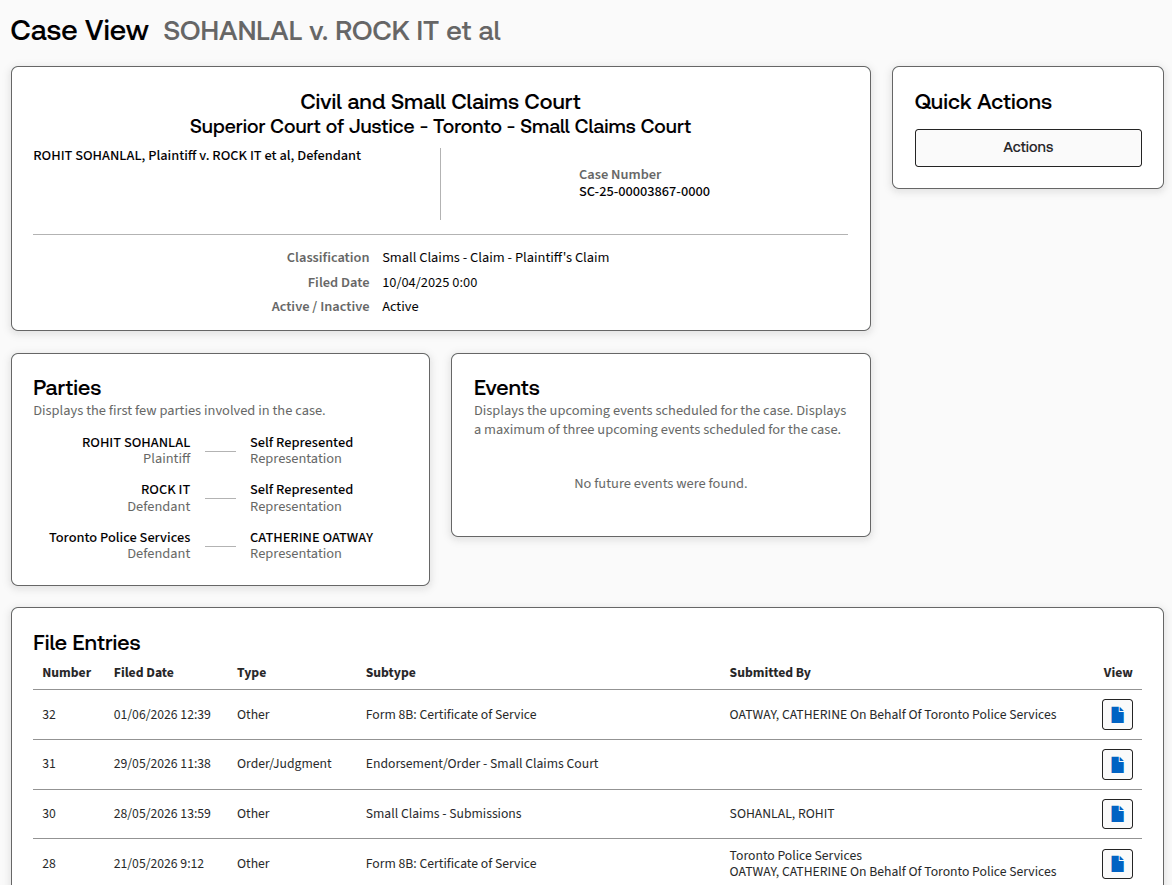
My claim was filed in the Toronto Small Claims Court under Court File No. SC-25-00003867-0000. The defendants identified in the proceedings include Rock IT (RockIT), the Royal Canadian Mounted Police (RCMP), and Toronto Police Services / Toronto Police Service Board (TPSB). The court-file material also identifies Catherine Oatway as counsel associated with Toronto Police Services.
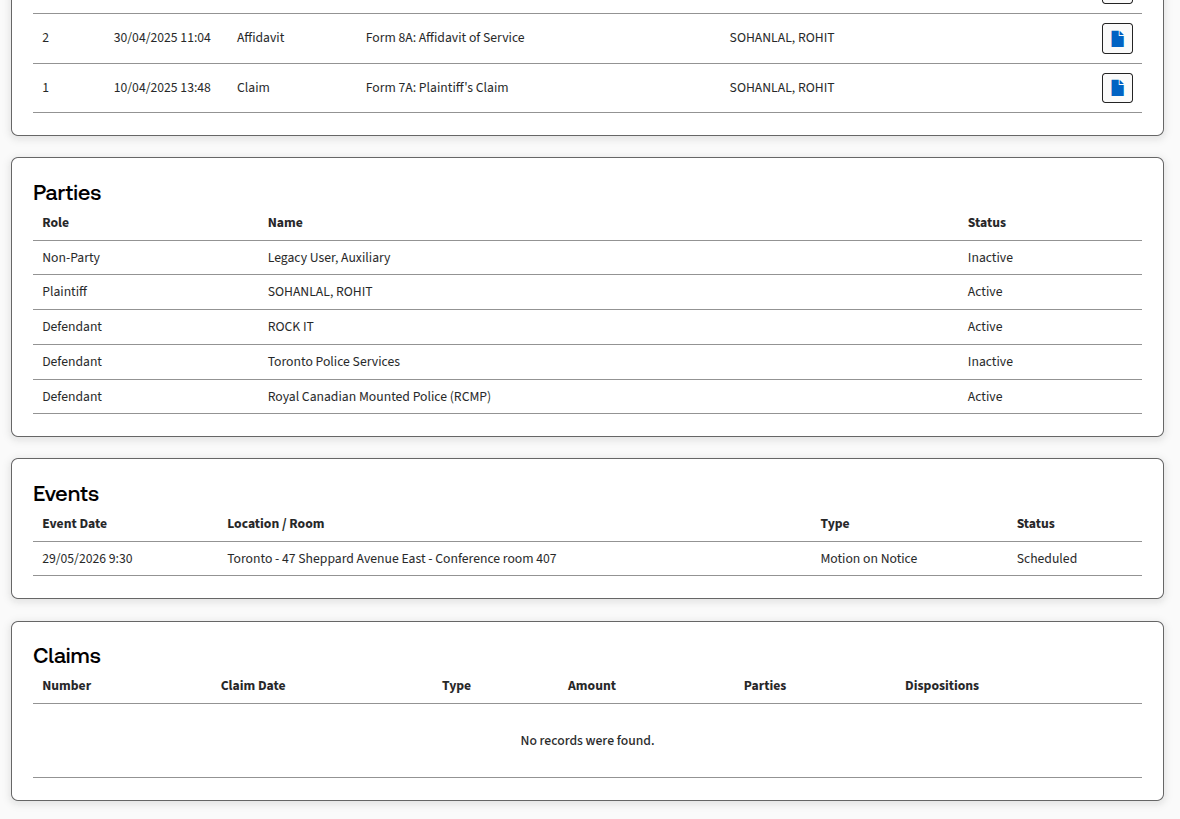
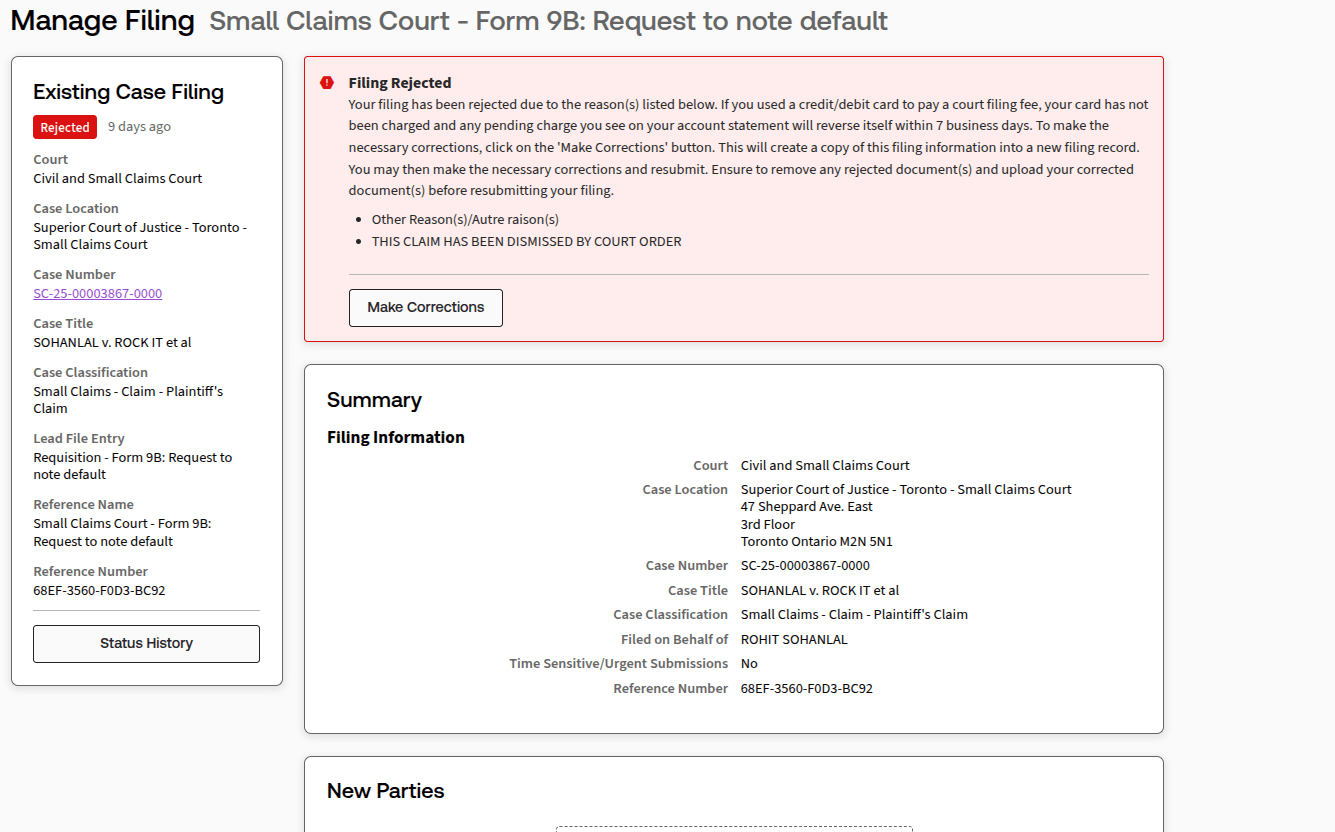
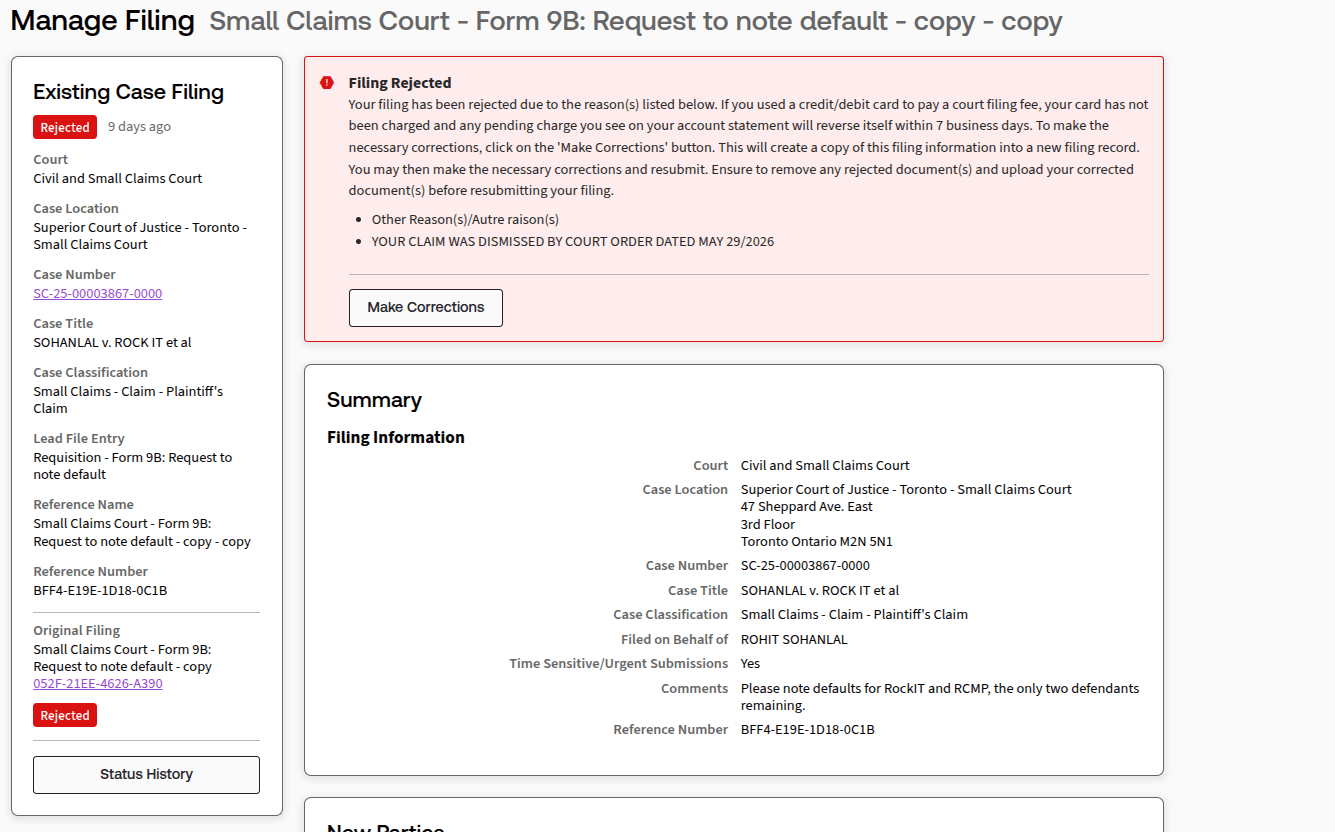
The accompanying images reproduce the relevant court-file screens, including the case information, party status, filing history and later Form 9B rejection notices.
My claim describes alleged harassment, disclosure of private information, conduct by people who claimed connections to police or the RCMP, and alleged bodily and sexualized violations. I also sought objective evidence—particularly surveillance footage—that could confirm or contradict what I reported.
My position is not that a court should simply accept my account. My position is that the evidence should be examined.
The RockIT Evidence
The claim identifies RockIT as a defendant and describes events involving staff, patrons and unidentified individuals whom I believed were connected to a wider pattern.
Most importantly, I requested video surveillance with audio from the relevant visits. The claim expressly identifies surveillance footage from the establishment as evidence supporting the case.
That evidence matters because surveillance can potentially establish facts independently of competing recollections: who was present, where people were positioned, who approached me and what happened inside the premises.
It could support my account.
It could also contradict it.
That is precisely why I wanted it examined.
The claim also contains transaction records establishing my presence at the establishment.
RockIT’s Participation Was Important
RockIT was important because it was not simply another defendant. It was the physical location where the alleged conduct occurred and potentially possessed independent video and audio evidence.
Its participation therefore mattered.
RockIT could have addressed the allegations through its own records, surveillance, witnesses and other evidence. Its participation could have clarified what happened and could have either supported or contradicted my account.
That is exactly what a functioning adversarial process is supposed to permit.
From my perspective, however, RockIT did not meaningfully participate in the way I expected, and the surveillance evidence I requested was not produced to me.
That leaves an important evidentiary gap.
This is especially significant because there was not just one potential source of evidence. There were multiple categories: surveillance, transaction records, contemporaneous recordings, police-report history and the court record.
When multiple independent sources can potentially test a claim, the merits should be determined by examining those sources.
Contemporaneous Records and Bodily Violations
I made contemporaneous voice notes concerning what I experienced. The claim records alleged pulses around my body, alleged ultrasonic audio near my seat and conduct that I interpreted as directed toward an intimate part of my body. Raw audio files were identified in the claim.
I characterize these incidents as bodily violations and sexualized harassment.
I have continued to experience what I perceive as similar bodily violations and sexualized conduct. In my view, that makes the failure to resolve the underlying questions more serious because the alleged harm is not merely historical: I continue to report financial, physical and psychological consequences.
Those continuing allegations remain my allegations. They have not been established by a judicial finding. But they are precisely the type of allegations for which objective evidence and competent investigation are important.
The Alleged Group and Claims of Police Affiliation
My claim describes people I called “audio broadcasters” and alleges that some claimed to be associated with police or the RCMP. It further alleges similar conduct in transit, commercial establishments and private spaces.
The question of affiliation is critical.
I cannot establish that someone was a police officer or RCMP member merely because the person claimed to be one.
But if individuals were falsely claiming police or RCMP authority while engaging in intimidation or criminal conduct, that would itself be serious.
If they actually had an institutional connection, the implications would be even more serious.
In either case, the identity and affiliation of such individuals should be capable of investigation.
Police Reports Were Already Being Made
The RockIT events did not occur in isolation from my perspective.
My claim states that I had been contacting Toronto Police concerning harassment and alleged disclosure of private information. It also records similar alleged incidents at other locations, including my housing, and information provided to Durham Regional Police.
This is particularly important because these reports were occurring in parallel with the events later described in the RockIT litigation.
I was not simply reporting one isolated incident.
I was reporting what I believed to be recurring conduct.
That creates a basic institutional question:
What did the police know, and when did they know it?
It also raises another:
Were the reports from different locations ever examined together?
A report does not prove the allegation contained in it. But the existence of the report establishes institutional notice and creates a record that can be investigated.
The Housing and Litigation Context
The claim states that similar alleged harassment occurred at my Toronto residence and at a previous Whitby residence. It says that multiple police calls were made and that information was provided to Durham Regional Police concerning the Whitby events. It also states that, during the RockIT period, I was preparing a response in another civil proceeding in which the same group could have become relevant as the litigation developed.
That matters because the alleged conduct, the police reporting and the litigation were occurring in parallel.
From my perspective, the same people, methods or information appeared across different environments.
That does not automatically establish coordination.
But it creates a factual question that should be tested against records.
What Is the RCMP’s Role?
The Royal Canadian Mounted Police (RCMP) is a named defendant in the proceeding. Its presence is significant because my allegations concern people who, I say, repeatedly claimed police or RCMP affiliations.
I also believe it is important to state the institutional point accurately: the RCMP is not simply an appeals body for every unresolved local police matter. Its jurisdiction is defined by federal law and its policing responsibilities, while local policing generally remains the responsibility of provincial, territorial or municipal services.
Nevertheless, where allegations specifically involve purported RCMP affiliations, federal jurisdiction, organized or cross-jurisdictional conduct, or conduct requiring RCMP involvement, the question of whether the RCMP was notified and what it did becomes relevant.
My question is therefore straightforward:
Was the RCMP ever able to determine whether the alleged claims of affiliation were genuine, false or entirely unrelated to the organization?
The Toronto Police Service Board
The Toronto Police Service Board (TPSB) is also important because it provides civilian governance and oversight of the Toronto Police Service.
My concern is not that the Board should direct individual investigations. It is whether the oversight structure worked appropriately when repeated complaints were being made.
If someone repeatedly reports serious conduct involving police impersonation, harassment or bodily violations, there should be a mechanism for ensuring that those concerns are documented, reviewed and, where necessary, escalated through appropriate channels.
The question is one of accountability:
What happened to the complaints after they entered the policing system?
The court-file screenshots that accompany this article show Toronto Police Services as inactive in the proceeding, while RockIT and the RCMP are shown as active.
From my perspective, TPSB/Toronto Police Services succeeded in becoming inactive in the litigation without the underlying allegations being determined on their merits.
That is significant to me.
Catherine Oatway
The court-file screenshots identify Catherine Oatway as counsel associated with Toronto Police Services.
I do not allege that she personally participated in the conduct I reported.
Publicly available legal publications identify Oatway as Counsel, City of Toronto. She is also the author of Competing Constitutional Rights: Developing the Canadian Approach, published in the McGill Law Journal. The article examines how competing Charter rights should be reconciled and emphasizes rights-respecting, proportionate approaches when rights conflict.
Her professional background does not establish anything about the underlying allegations in my case.
For me, her significance is institutional: she was counsel representing the Toronto police interests in the litigation.
The questions remain:
What reports existed? What evidence existed? What had the police institution been told? And what position was ultimately taken in court?
What Happened in Court
The accompanying court-file images show an Endorsement/Order – Small Claims Court, subsequent service records, and party-status information showing Toronto Police Services as inactive while RockIT and the RCMP are shown as active.
I subsequently attempted to file Form 9B requests to note default against RockIT and the RCMP.
Those requests were rejected.
The rejection stated that:
“THIS CLAIM HAS BEEN DISMISSED BY COURT ORDER.”
One of the filings expressly stated that I was seeking defaults against RockIT and RCMP, the only two defendants remaining.
This is a critical part of the story because the ordinary Small Claims process provides a mechanism for dealing with defendants who fail to defend. The court form itself warns defendants that failure to file a defence can result in judgment without notice.
The electronic case history therefore presents a difficult sequence from my perspective:
Toronto Police Services became inactive.
RockIT and the RCMP remained the defendants I was pursuing.
I sought default against them.
The default requests were rejected on the stated basis that the claim had already been dismissed.
The question therefore becomes:
What exactly did the court order determine, and why did later default applications receive the stated response?
The electronic record should answer that question.
The accompanying screenshots are intended to allow readers to see the party-status information and the rejection notices for themselves.
RockIT, the Evidence, and the Police Defendants’ Response
The significance of RockIT is that the participation and evidence were potentially capable of independently testing the allegations.
That evidence was part of the proceedings.
The police defendants and their lawyers therefore had an opportunity to engage with the evidentiary record, including the alleged incidents, the surveillance issue, the prior police reporting and the other documentary material.
From my perspective, they either deny the substance, do not meaningfully engage with it, or do not appear interested in obtaining evidence that they could potentially obtain themselves.
The police were already aware of my reports. If police records existed, the police defendants could potentially obtain and review them independently. I do not believe there has been meaningful interest in doing so.
Their lawyers, in my view, have also not shown meaningful interest in the underlying evidentiary questions.
That is deeply frustrating because this case should be about what happened, not merely about which side can obtain the better procedural outcome.
When a Procedural Outcome Becomes a “Win”
This is one of my strongest concerns.
If a court does not fully understand the factual or evidentiary background, and a party succeeds by feeding whatever procedural information is necessary into the justice system to obtain a favourable outcome, that can look like a victory even though the underlying merits have never been determined.
From my perspective, that is not the same as winning on the merits.
It is possible to celebrate a procedural result while never answering:
What happened?
What evidence existed?
Who participated?
Who knew?
What did the surveillance show?
That is why I remain focused on the evidentiary record.
Defaults and the Status of the Defendants
My understanding of the proceedings is that RockIT and the RCMP were the defendants against whom I ultimately sought default, while Toronto Police Services had become inactive.
The court record and accompanying screenshots therefore leave me with a sequence in which TPSB/Toronto Police Services became inactive, while my efforts to obtain default treatment against RockIT and the RCMP were rejected.
Whether those results were legally correct is a matter for the complete court record.
But the sequence is important because, from my perspective, none of it resulted in a determination of the substantive allegations.
Why I Believe the Court Treatment Was Discriminatory
I believe the treatment I received in the court process was discriminatory.
That is my opinion based on my experience, not a judicial finding.
I do not reach that conclusion because of one rejected filing. I reach it from what I perceive as a cumulative pattern: serious allegations, contemporaneous documentation, requests for independent surveillance, prior police reporting, institutional defendants, and procedural outcomes that, from my perspective, repeatedly prevented the underlying evidence from being properly tested.
I am self-represented.
The other side includes public institutions with substantial legal and administrative resources.
At times, I felt that court personnel were not merely processing my filings but giving me what I can only describe as a “psychological hit”—something that seemed designed, from my perspective, to discourage me, unsettle me or make me abandon the process.
I cannot know another person’s subjective intention.
I can describe the effect.
For me, it felt discriminatory.
The Alleged Conduct Continues
The most troubling issue is that the alleged conduct has not, in my experience, ended with the litigation.
I continue to report what I perceive as bodily violations, sexual assaults or sexualized attacks, targeted harassment and conduct that appears designed to cause harm without necessarily leaving conventional physical marks.
I have described this as resembling “no-marks torture”: conduct that, if it occurred as perceived, could cause physical and psychological suffering while leaving little or no visible injury.
I have also perceived conduct that appears highly targeted and adaptive—tracking or sensing my location or activity and then using that information to engage in harassment or mischief.
I emphasize again: these are my perceptions and allegations, not established technological or judicial findings.
But if people involved are genuinely claiming police or RCMP authority, an obvious question remains:
Why would such conduct be permitted to continue?
And if they are falsely claiming affiliation, the question becomes:
Why has that apparent impersonation not been conclusively addressed?
Intimidation of Justice Participants
The continuation of alleged harassment while litigation is underway raises an additional concern: intimidation of a participant in the justice process.
I believe that any attempt to intimidate, frighten, pressure or retaliate against a litigant because that person is reporting misconduct or participating in litigation would be a matter requiring serious attention.
I do not assert as an established fact that court personnel or defendants coordinated such intimidation.
My concern is that the possibility should not be ignored simply because it is uncomfortable to investigate.
If the alleged conduct continued during litigation, that chronology itself is relevant.
The Use of a Custom Technology-Assisted System
I have become concerned that what I am experiencing may involve a highly personalized, potentially AI-assisted system capable of coordinating harassment.
My concern includes the possibility of a system used to facilitate:
- targeted mobbing;
- coordinated harassment;
- intimidation;
- assaults and sexual assaults;
- cyber-voyeurism;
- surveillance or tracking;
- coordinated litigation interference;
- collusion between participants;
- and adaptive harassment based on information about the target.
I am not claiming that the present court record proves the existence of an AI-assisted weapon or such a system.
It does not.
I am explaining why I believe the possibility deserves proper investigation.
The distinguishing feature of my concern is the alleged personalization and coordination: conduct that appears to adapt to where I am, what I am doing, whom I contact or what proceedings I am pursuing.
If that perception is wrong, evidence should establish that.
If emerging technologies are actually being misused in such a manner, the consequences would extend far beyond one lawsuit.
The Central Evidentiary Problem
For me, the case keeps returning to the same point.
There is evidence that can potentially be checked.
There is surveillance that was requested.
There are contemporaneous recordings.
There are transaction records.
There are police reports.
There is a court record.
There are filings showing the status of parties and subsequent rejection of default requests.
The problem is that these evidence streams have not, in my view, produced a coherent explanation.
That is why I continue to ask:
What was known?
Who knew it?
When did they know it?
What was preserved?
What was investigated?
What was disclosed to the court?
Why were the default applications rejected?
And, ultimately:
Why has the underlying conduct not been conclusively established or disproved?
Current Status
As reflected in the court-file screenshots accompanying this article, Toronto Police Services is shown as inactive, while RockIT and the RCMP are shown as active parties. The later Form 9B applications seeking default against RockIT and the RCMP are shown as rejected on the stated basis that the claim had already been dismissed by court order.
Accordingly, the present electronic record does not, by itself, provide the clarity I believe is necessary about the substantive status of the underlying allegations.
The precise legal effect of the relevant order must be determined from the actual order and complete court record.
Conclusion
I do not expect a court to accept my allegations simply because I made them.
I expect a court to examine them.
If surveillance disproves my account, let it be shown.
If police records demonstrate that my complaints were properly investigated, let the records establish that.
If the alleged broadcasters had no connection to the police or RCMP, that should be established.
If there was a connection, that should also be established.
If the May order disposed of the entire case, the actual order should make that clear.
If it did not, the procedural record should explain what happened.
That is what evidence is for.
My position remains that the treatment I experienced in the court process was discriminatory, and that some interactions felt like a deliberate psychological blow intended to make me stop pursuing the matter.
I also remain concerned about continuing alleged bodily violations, sexualized attacks, coordinated harassment and conduct that I perceive as technologically assisted and increasingly personalized.
Those allegations have not been judicially proven.
But neither should serious allegations be dismissed merely because they are difficult to understand.
The appropriate response is evidence, investigation and transparency.
That is what I believe the justice system owes every participant—including a self-represented litigant.
Qualification
This article presents my perspective and allegations contained in my court materials. The allegations have not been established as findings of fact unless determined through admissible evidence or judicial decision. The electronic court screenshots show entries and statuses displayed in the court system, but the precise legal effect of the relevant order should be determined from the actual order and complete court record. The accompanying images are provided so readers can independently review the court-file information described in this article.