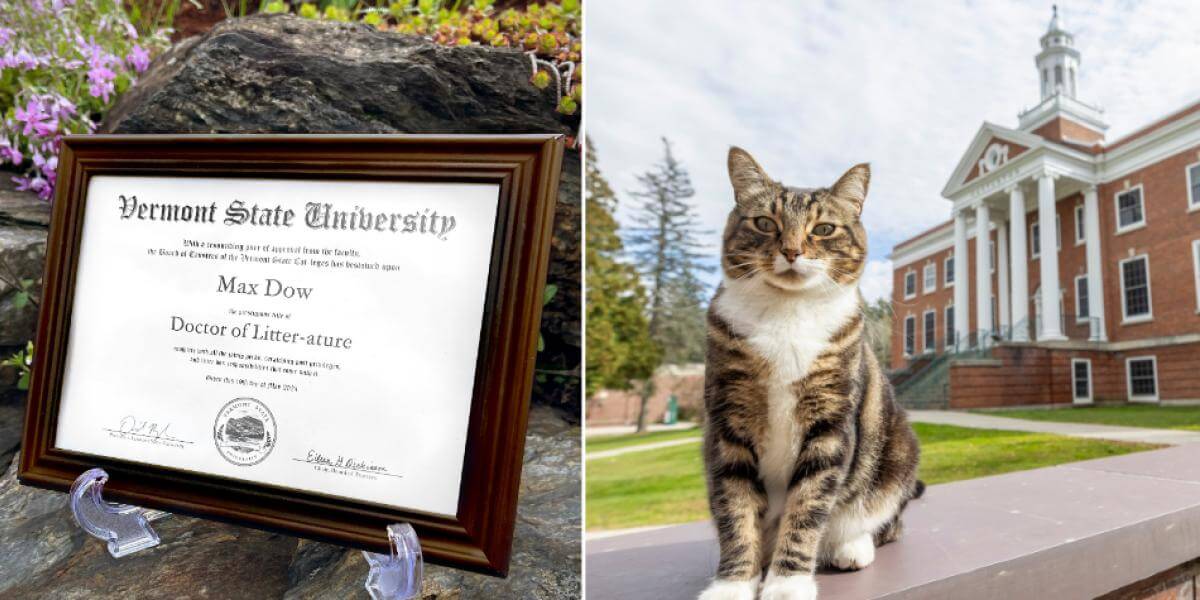
Max the Cat, a beloved fixture of Vermont State University’s Castleton campus, received an honorary “Doctor of Litter-ature” degree in 2024.
In May 2024, Vermont State University’s Castleton campus awarded an honorary doctorate to an unlikely graduate: a tabby cat named Max. Officially recognized as a “Doctor of Litter-ature,” Max joined the university’s Class of 2024 after spending years roaming campus, accompanying students, appearing in photographs, joining tours, and becoming an unofficial symbol of campus life.
At first glance, the story appears to be little more than a lighthearted human-interest piece. Yet the widespread public reaction to Max’s honorary degree reveals something deeper about the role of community, belonging, and emotional well-being within educational institutions.
Max lived near the Castleton campus and gradually became a familiar presence among students and staff. According to university accounts, he spent approximately four years socializing on campus—the same amount of time many students spend earning an undergraduate degree. During that period, he rode on backpacks, followed campus tours, visited classrooms, and became a frequent subject of student photography projects.
The university’s decision to honor Max was intentionally humorous. His diploma included cat-themed language, granting him “catnip perks” and “scratching post privileges.” Yet administrators emphasized that the recognition reflected his genuine contribution to campus culture. Students reportedly sought him out during stressful periods, and staff observed how interactions with him appeared to lift moods and encourage social connection.
Research has long demonstrated the positive effects of human-animal interactions on stress reduction and emotional well-being. While Max was not a formal therapy animal, students frequently described him as an informal source of comfort. His presence created spontaneous moments of connection among people who might otherwise have remained isolated within the pressures of academic life.
Perhaps most remarkable is how deeply Max became integrated into the university community. Vermont State University created a faculty directory page for him and even provided an institutional email address. His online profile includes playful “wisdom” about enjoying life, making others happy, and appreciating simple comforts.
Community reaction further illustrates his significance. When Max was absent during colder months, students reportedly created a small shrine featuring his photograph. Alumni returning to campus often asked about his well-being, and online discussions celebrated the honorary degree with enthusiasm and humor. Several commenters described Max as one of the brightest aspects of campus life during challenging academic periods.
In an era when universities increasingly focus on student mental health, retention, and campus engagement, Max’s story serves as an unconventional reminder that institutional culture is shaped not only by policies and programs but also by shared experiences. Community is often built through small, everyday interactions rather than formal initiatives alone.
The honorary doctorate did not recognize scholarly achievement. Instead, it acknowledged a different kind of contribution: fostering connection. Universities traditionally celebrate intellectual accomplishment, but they also depend on social bonds that make learning environments welcoming and resilient. By honoring Max, Vermont State University highlighted the value of those less tangible contributions.
Whether viewed as a clever publicity effort, a tribute to a beloved campus figure, or an illustration of the therapeutic value of animals, the story resonated because it reflects a universal truth. People remember communities not only for their buildings, rankings, or academic programs but also for the relationships and experiences that make them feel connected.
Max the cat may never write a dissertation, publish a journal article, or teach a lecture. Yet his honorary doctorate recognizes something many graduates learn during their time at university: success is not measured solely by credentials. It is also measured by the positive impact one has on the lives of others.
For that reason, “Dr. Max Dow” may be one of the most memorable graduates of the Class of 2024.
References
Associated Press. (2024, May 19). A college puts the “cat” into education by giving Max an honorary “doctor of litter-ature” degree.
Free, C. (2024, June 5). Cat roams university campus for 4 years, gets doctoral degree. The Washington Post. Retrieved via syndicated publication.
Reed, E. (2024, May 15). Meet Max, the cat receiving an (honorary) doctorate from Vermont State University this weekend. Vermont Public.
Vermont State University. (2024). Max the Cat. University directory.
Vermont State University. (2024). Max the Cat receives honorary degree. University news release.