
By Graphics Systems & Engine Architecture Analysis
1. The Numbers Trap: How Marketing Convinced Gamers to Chase Numbers Over Quality
For nearly two decades, real-time graphics engineering advanced through a shared contract with gamers: compute cycles were expended to deepen scene complexity, resolve micro-geometry, and approximate real-world optics. Over the past several product cycles, however, that contract underwent an ideological pivot. Silicon vendors and marketing departments realized an uncomfortable reality: brute-force rasterization and uncompromised light simulation scale non-linearly with transistor budgets, whereas raw frames per second (FPS) can be mass-marketed as an easily quantifiable metric of superiority.
The consumer graphics market is currently saturated with headline performance figures that obscure visual compromise. Benchmark charts proudly display frame rates exceeding 144 to 240 FPS at “4K,” yet an inspection of the render pipeline reveals that native resolution is rarely touched. Instead, modern pipelines routinely render internally at 1080p or lower, run aggressive neural reconstruction, and insert multiple synthetic interpolated frames using AI optical flow and predictive transformers (e.g., NVIDIA DLSS 4 and DLSS 4.5 Multi-Frame Generation, AMD FSR (FidelityFX Super Resolution), Intel XeSS (Xe Super Sampling), ARM NSS (Neural Super Sampling) and Arm ASR (Accuracy Super Resolution)).
The result is a strange paradox: on paper, the performance counter reads triple digits; in practice, the viewer observes ghosting, edge boiling, disocclusion smear, and high latency. The industry has substituted perceived motion fluidity for foundational optical fidelity. What real-world visual engagement demands is not an artificial 180 FPS achieved through hallucinated intermediate frames, but a bedrock of perceptual realism: rock-solid frame pacing above 30 to 60 FPS, uncompromising high-frequency micro-textures, native 1:1 physical pixel matching, and accurate light transport.
2. The Perceptual Foundation: Native Pixel Grids, High-Frequency Textures, and Stable Frame Timing
To understand why excessive frame extrapolation and neural scaling fail to convince the human visual cortex, one must examine how physical display matrices register rendered data.
2.1 Resolution Must Equal the Physical LED/Subpixel Matrix
A digital flat panel does not present continuous mathematical curves; it operates on a rigid semiconductor lattice of discrete physical emitters—most commonly configured as Red, Green, and Blue (RGB) or organic/quantum-dot stripes (OLED/QD-OLED).
When an engine renders at a resolution that directly matches the physical emitter count (1:1 native rasterization), every computed sample maps to an exact, uncompromised physical subpixel coordinate. The moment an upscaler projects an internal 1080p frame buffer onto a 3840×2160 display, three out of every four pixels (75% of the spatial data) do not exist. They must be algorithmically synthesized across temporal history buffers, depth buffers, and optical flow vectors.
+-------------------------------------------------------------------------+
|                  NATIVE SUBPIXEL MAPPING (1:1)                          |
|  [ R | G | B ]   [ R | G | B ]   [ R | G | B ]   [ R | G | B ]          |
|  Direct memory-to-emitter mapping: Pristine edge contrast, zero drift   |
+-------------------------------------------------------------------------+
|              TEMPORAL / NEURAL UPSCALED MATRIX (INTERPOLATED)           |
|  [ R | G | B ] ~ [ R | G | B ] ~ [ R | G | B ] ~ [ R | G | B ]          |
|  Synthesized history buffers: Softened high frequencies & ghosting      |
+-------------------------------------------------------------------------+
This structural deficit produces a distinct visual degradation:
- Loss of High-Frequency Resolving Power: Rather than a simple Gaussian blur, surfaces lose their micro-contrast. Fine structural elements—such as wire fences, geometric vegetation alphas, power lines, and screen-space caustics—dissolve into a muddy, watercolor-like softness.
- Temporal Smearing and Disocclusion Trails: When moving objects reveal background pixels that were absent in previous frames, the reconstruction algorithm lacks historical data. The resulting image exhibits ghosting trails, edge boiling, and disocclusion smearing across motion vectors.
- Unnatural Ringing Artifacts: To mask the intrinsic softness of temporal reconstruction, pipelines routinely apply aggressive sharpening passes. This introduces localized luminance haloing and harsh edge ringing around high-contrast contours, betraying the natural falloff of real-world optics.
In contrast, an unscaled native frame on an RGB subpixel display maintains optical integrity: hard edges remain razor-sharp, text is legible at subpixel boundaries, and moving silhouettes stay temporally stable without smearing or shimmer.
2.2 Texture Density and Geometry Over Frame Interpolation
Human scene comprehension is rooted in tactile material interaction. A viewer moving through a complex physical environment perceives realism through micro-cracks, surface porosity, dynamic specular roughness, and geometric displacement—qualities driven strictly by high-resolution texture maps, dense vertex pipelines, and high memory bandwidth.
Allocating GPU die area, memory bus width, and compute cycles to synthesize intermediate, interpolated frames directly starves the underlying render pipeline. A fluid yet hallucinated 120 FPS stream cannot compensate for compressed mipmaps, aggressive LOD pop-in, and stripped specular details.
Real immersion is achieved by delivering an uncompromised foundation: a judder-free, strictly frame-paced 30 to 60 FPS powered by uncompressed 4K source assets and a 1:1 physical pixel pipeline. Prioritizing native structural presence over artificial motion smoothness aligns with how the human visual system processes the physical world.
3. The Ray Tracing Illusion: Why Gamers Switch It Off
When hybrid real-time ray tracing (DirectX Raytracing / Vulkan RT) arrived in consumer GPUs, it was heralded as a generational revolution. Yet in community forums and telemetry data, a widespread habit emerged: users routinely toggle ray tracing off after the initial novelty fades.
This behavior is driven by two factors:
- The Performance Cliff: Basic hybrid ray tracing (typically restricted to 1 ray per pixel for simple reflections or ambient occlusion) incurs a 40% to 60% hit to raw performance.
- Negligible Perceptual Gains: In fast-moving real-time gameplay, hybrid ray tracing replaces screen-space reflections (SSR) and precomputed shadow maps with localized stochastic ray hits. However, because hardware limits these implementations to extremely sparse sampling, engines rely on aggressive spatio-temporal denoisers (SVGF, NRD). These denoisers blur spatial details across temporal history frames, smearing fine specular highlights and causing shadows to trail behind moving characters.
Players quickly deduce that losing half their native responsiveness for subtle, often muddy reflections is an unfavorable trade-off.
4. Path Tracing: Unpacking Rays, Bounces, and the Law of Diminishing Returns
Unlike hybrid ray tracing—which patches ray-tested queries onto an otherwise rasterized G-buffer—Path Tracing resolves global illumination by tracing stochastic optical paths from the virtual camera sensor back through the environment to emissive light sources, capturing direct illumination, indirect diffuse inter-reflections, specular refractions, and caustics simultaneously.
In a real-time path tracer, visual fidelity is determined by two independent variables:
- Ray Count (Samples Per Pixel – SPP): The number of discrete exploratory light vectors sent into the scene per pixel. Higher ray counts reduce Monte Carlo stochastic variance (visual grain/noise).
- Bounce Count (Path Depth): The number of times a single ray is allowed to reflect or refract off surfaces before terminating. Higher bounce counts calculate deep diffuse inter-reflections and complex specular transmission.
4.1 Visual Simulation Analysis: The Test Chamber Matrix
Path Tracing Parameter Matrix (No Denoiser)
| Parameter Tier | Visual State | Impact on Scene Quality |
| 2 Rays, 8 Bounces | Severe Noise / Muddy | Heavily starved sampling yields extreme grain (“fireflies”) and clipped dark crevices. |
| 8 Rays, 8 Bounces | Coherent Global Illum. | Indirect bounces successfully fill occluded corners; minor specular noise remains. |
| 16 Rays, 8 Bounces | Perceptual Threshold | Noise becomes imperceptible to the human eye; glass caustics and diffuse gradients look pristine. |
| 64 Rays, 8 Bounces | Diminishing Returns | Mathematical variance converges further, but visual output is identical to 16 rays while compute cost explodes. |
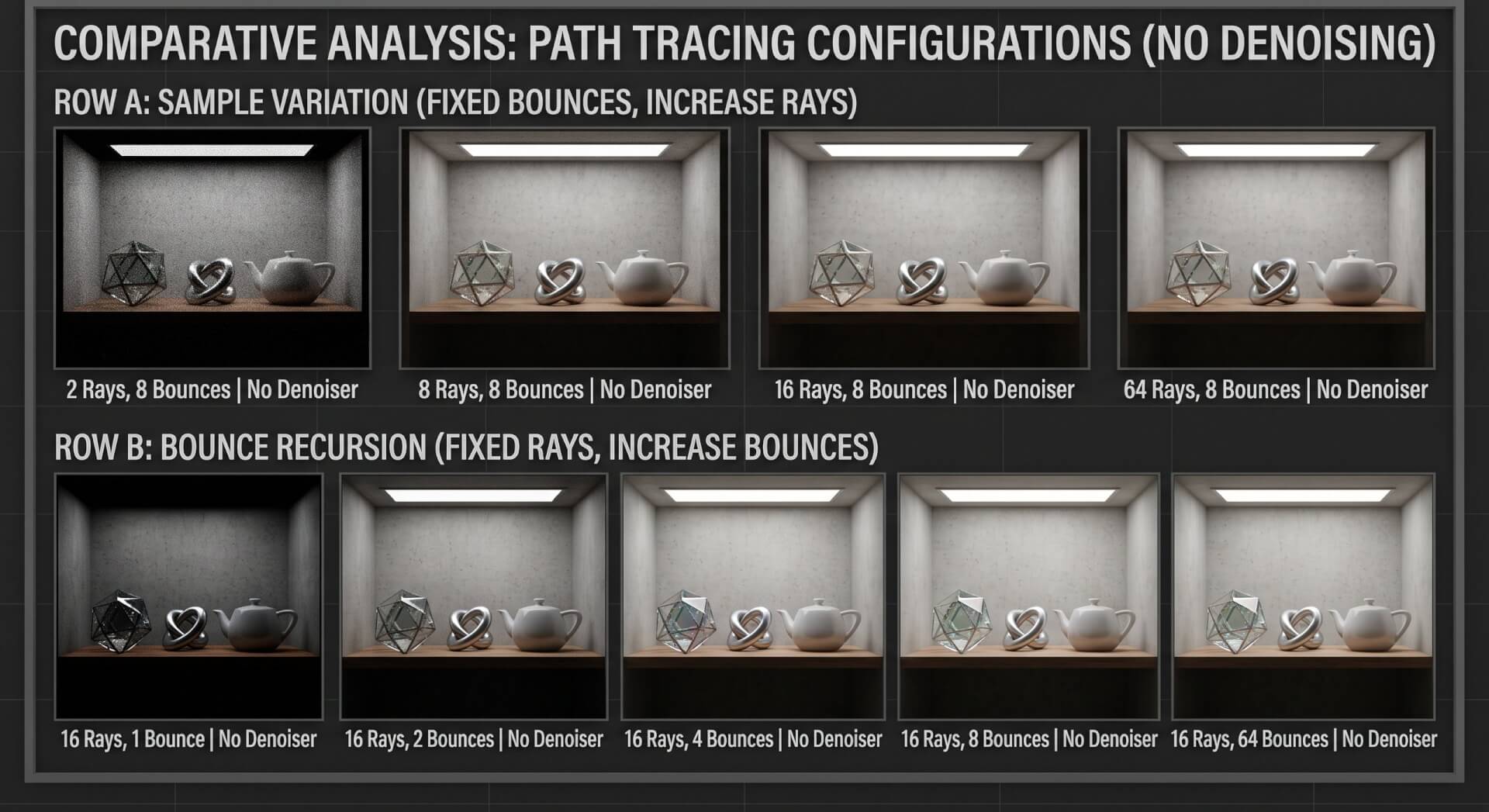
The Visual Progression Across Configurations:
- 2 Rays, 8 Bounces (Under-Sampled Failure):At 2 rays and 8 bounces, the scene is visually fractured. Because 2 rays per pixel fail to capture the hemispherical distribution of indirect light, variance is astronomical, producing dense salt-and-pepper noise (“fireflies”). Although bounce depth is high, the lack of sufficient primary rays means secondary reflections hit scattered invalid spots: the objects and floor remain heavily speckled with grain.
- 16 Rays, 1 Bounce vs. 16 Rays, 4 Bounces:Increasing rays to 16 completely suppresses spatial noise on directly lit walls. However, if bounces are capped at 1, the scene feels flat and artificially high-contrast; light cannot navigate multiple folds of geometry or refract through the glass. Pushing bounces to 4 or 8 immediately allows light from the bright floor to bounce up into ceiling recesses and illuminate internal glass refractions.
- 16 Rays, 64 Bounces (The Deep Recursion Paradox):Allowing 64 bounces with 16 rays calculates hyper-deep light transport paths. However, past 8 to 16 bounces, most surfaces have already absorbed or reflected the available radiometric energy. The visual output between an 8-bounce pass and a 64-bounce pass is virtually indistinguishable, proving that extreme bounce limits waste hardware performance.
- 16 Rays, 16 Bounces (The Optimal Convergence Sweet Spot):At 16 rays and 16 bounces, the render reaches visual convergence. Multi-bounce diffuse inter-reflections cascade naturally into every occluded corner. Caustics through the glass polyhedron resolve with clean gradients, and the specular highlights on the metallic sculpture reflect the environment without temporal distortion.
- 32 Rays, 32 Bounces up to 64 Rays, 64 Bounces (The Asymptotic Wall):Increasing parameters to higher tiers quadruples the mathematical ray-intersection work, yet the resulting image is visually indistinguishable from 16×16. The Monte Carlo error reduces at an asymptotic rate. The tiny changes in luminance occur entirely below the threshold of human visual perception (Just-Noticeable Difference / Weber-Fechner Law) and standard dynamic range display capabilities.
5. The Hardware Reality: What We Actually Need
The graphics hardware industry has drifted into marketing performance multipliers—proclaiming 4x frame rate increases via temporal interpolation, dynamic multi-frame generation, and deep-learning reconstructors. But when synthetic frames introduce input latency and spatial artifacts, the user experience deteriorates.
+-----------------------------------------------------------------------------+
|                           THE FIDELITY PYRAMID                              |
|                                                                             |
|      [ ]  High-Order Multi-Frame Generation (Excessive / Artifact-Prone)    |
|     [---] 32+ Ray / 32+ Bounce Path Tracing (Diminishing Visual Returns)    |
|    [-----] 16 Rays / 16 Bounces Path Tracing (Optimal Convergence Peak)     |
|   [-------] Native Display Resolution (1:1 Physical LED Pixel Alignment)    |
|  [---------] Rock-Solid Frame Pacing (>= 30–60 FPS Zero Frame Judder)        |
+-----------------------------------------------------------------------------+
True visual immersion requires a realignment of engineering priorities:
- A Resilient Baseline of Frame Delivery: We need frame pacing locked to integer refresh cycles ($\ge 30$ FPS for cinematic single-player, $\ge 60$ FPS for standard interaction) without dropped frames, frame-time spikes, or artificial frame-generation latency.
- Physical Native Pixel Alignment: Display engines must preserve native resolution matching the physical subpixel grid of the monitor. Edge detail, high-frequency alphas, and fine text should be rendered natively rather than smeared across neural upscaling filters.
- High-Fidelity Textures & Geometric Density: Hardware memory pipelines should prioritize massive VRAM capacity and ultra-wide memory buses to feed uncompressed 4K and 8K texture buffers, maximizing tangible physical detail on every surface.
- Targeted, Perceptually Bounded Path Tracing: Rather than wasting silicon on extreme bounce depths or masking sub-1-ray noisy passes with aggressive denoisers, game engines should target the 16 rays, 16 bounces convergence envelope.
Real-time graphics does not need more marketing-driven frame multipliers. It needs raw, uncompromised structural fidelity—grounded in the physics of light, the architecture of displays, and the natural limits of human perception.
References
- Akenine-Möller, T., Haines, E., & Hoffman, N. (2018). Real-Time Rendering (4th ed.). CRC Press.
- Betthauser, I., & Pharr, M. (2021). Fast, robust ray termination using Russian Roulette. Journal of Computer Graphics Techniques, 10(2), 1–18.
- Kajiya, J. T. (1986). The rendering equation. ACM SIGGRAPH Computer Graphics, 20(4), 143–150. https://doi.org/10.1145/15886.15902
- Mara, M., McGuire, M., Bitterli, B., & Jarosz, W. (2017). An efficient denoising algorithm for real-time ray tracing. High Performance Graphics (HPG), 4(1), 1–12. https://doi.org/10.2312/hpg.20171094
- NVIDIA Corporation. (2024). DLSS 4: Transforming real-time graphics with AI. NVIDIA Applied Deep Learning Research. https://research.nvidia.com/labs/adlr/DLSS4
- Pharr, M., Jakob, W., & Humphreys, G. (2023). Physically Based Rendering: From Theory to Implementation (4th ed.). MIT Press.
- Schied, C., Kaplanyan, A., Wyman, C., Patney, A., Chaitanya, C., Burgess, J., Liu, S., Dachsbacher, C., Kautz, J., & Lefohn, A. (2017). Spatiotemporal variance-guided filtering: Real-time reconstruction for path-traced global illumination. High Performance Graphics (HPG), 2(1), 1–12. https://doi.org/10.1145/3105762.3105770